Originally published April 19, 2024 Latest Update April 18, 2026
Find easy no/low prep Earth Day music activities, songs, and games for elementary classrooms using rhythm, movement, and singing!
What’s the history of Earth Day?
According to Earthday.org, “…founders created and organized the very first Earth Day on April 22, 1970. Since then, (it) has been mobilizing over 1 billion people annually on Earth Day, and every other day, to protect the planet.”
Originally published April 3, 2024 Latest Update April 3, 2026
Learn about jazz with these EASY jazz music lessons & activities using instruments, singing, movement, and creating. Perfect for K-8 elementary music.
Jazz is perfect all year long but can be a special emphasis in February for Black History Month, March for Women’s History Month, or April for Jazz History Month.
Table of Contents
This post may contain affiliate links. I make a small commission at no additional cost to you. Read my full disclosure.
Originally published April 4, 2021 Last Update April 9, 2026
Looking for simple and fun ways for your music classes to be active and engaged outdoors? Check out these easy outdoor music and movement activities for kids! Why outdoors? To enjoy the weather, quiet time during testing, or just a change of scenery for a brain break.
Table of Contents
This post may contain affiliate links. I make a small commission at no additional cost to you. Read my full disclosure.
Net Games
Use multiple setups for whole class play or just one for a station in learning centers. (see images & video below)
The GOAT (A Reverse HORSE Steady Beat Challenge)
The GOAT is a cooperative elementary music passing game where students work together to keep a steady beat while singing. Inspired by the basketball game HORSE, this version flips the idea: instead of earning letters for mistakes, students earn letters when they succeed.
🏆 The goal is simple: earn the letters G-O-A-T by singing and passing the ball correctly.
📋 This game encourages students to focus on the beat, teamwork, and accurate singing while staying fully engaged.
🔹 How to Play the GOAT Game
Students are in 2-person teams on opposite sides of a net. (4 total)
Both teams sings a familiar song or chant a rhyme while passing a ball on the *main beats.
Each pass or bounce should match the beat of the song.
🐐 If the teams sing the entire song without mistakes, they earn a letter. G.O.A.T. 🐐 When the teams spell GOAT, they win the challenge!
🔹 You have to start the song over if:
the hand touch on the ball isn’t on the *main beat (if the hand touch is on beat 1, the bounce is probably going to be on beat 2)
everyone isn’t singing
the ball doesn’t go over the net
*Passing to a STEADY beat isn’t the goal. Passing on the MAIN beat is the goal so their singing tempo may adjust to make it work.
🔹 What songs should I use to play GOAT? Choose songs already in your elementary music curriculum that have a strong, predictable beat. Folk songs and rhythmic chants work especially well because they are repetitive and easy for students to remember. Examples are Big Fat Biscuit, Dusty Bluebells, Pease Porridge, and I Never Saw a Purple Cow.
How to Set Up the Net
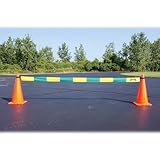
You can use 2 chairs and a piece of yarn for the cheapest and easiest setup!
Ask your PE teacher if they have these special nets or purchase for yourself.
I created GOAT after watching this PE class game in the video!
Students will compose short melodic phrases using commonly found household items, such as a rock to create “Melodies that Rock.” Younger students can explore music contour in relationship to high and low notes, while older students can write melodic patterns related to their grade level concepts.
Check out the full lesson plan at the VDOE Link below. Lesson plan was altered and adapted for outdoor sidewalk chalk activity.
Disclaimer: The Virginia Department of Education (VDOE) has not evaluated this resource for content nor accessibility. This material is provided “as-is” without warranties of any kind. Use professional expertise in evaluating and using this resource.
I learned about this game from our PE teacher and kids LOVE it. I tried to reconfigure it for music and came up with Pat, Clap, Snap. The objectives-
brain break
using body percussion
team building
Directions:
Two teams in rows. (red and blue above) The object of the game is to get your player from one end of the hula hoops to the other before the other team. Players must jump (2-footed) from one hoop to the next.
One person from each team begins. Those out go to the end of the line & the next person on your team begins at the beginning.
The red team begins at the green hoop. The blue team begins at the yellow hoop. The configuration of the hoops can be in any design as long as there are starting (ending) points for both teams. (In the gym or outside you have lots of room to curve the course all over the place.)
If your music room isn’t very big or you can’t use the gym or go outside, I think sit spots or bean bags would work. Instead of jumping IN the hoop, you’d jump over each spot/bag.
At some point the two players will meet (be facing each other) and that is when they’ll play Pat Clap Snap.
Instead of Rock, Paper, Scissors’ fist-fist-rock/paper/scissors, they will clap two times and then the third beat will need to either be a pat, clap, or snap. If they do the same motion, it’s a tie and they do it again until there’s a winner. The image above is a visual to help them remember what beats the other.
The winner keeps jumping, the loser goes to the end of their line and a new player for that team begins jumping, hoping to stop the other player. Here is the Rock, Paper, Scissors version.
Earth, Wind, and FIRE
Take any upbeat song such as Earth, Wind, and Fire’s “Let’s Groove Tonight” and create easy movement.
How to Move
Intro (stand and bounce to the beat)
Verse (lots of words so keep it simple-WALK to the beat)
Chorus (easier lyrics so stop and do simple choreography)
arms up, arms out, arms down, arms out (repeat)
Bridge (freestyle)
Walking and freestyle are a snap! Just something simple for the chorus and BAM, you’ve got it.
Discover simple, effective ways to teach movement in elementary music and help your students build creativity, confidence, and musicality.
Movement in elementary music can be more than a stress reliever, a brain break, a way to experience another culture, or other very worthy objectives. It can also be a way to empower ALL kids through positive interaction with the teacher.
I was scrolling social media and saw this quote.
“Go and love someone exactly as they are. And then watch how quickly they transform into the greatest, truest version of themselves. When one feels seen and appreciated in their own essence, one is instantly empowered.”
Wes Angelozzi
How do you teach movement in elementary music classes?
Observe your students and give positive and instructional feedback, which will lead to student empowerment and creativity.
Deep and meaningful connections with your students happen when you let them know what you notice!
Movement Lesson Observation Application
Here’s an example of how I’d apply these observation techniques for movement in elementary music.
The lesson is for kinders and first graders to move (step, skip, float) to changing music examples.
A spring classic for the elementary classroom is Vivaldi’s Spring from The Seasons. Are you looking for this classic taught with ACTIVE music-making?
This resource with lots of movement teaches students to play and sing (new Spring lyrics) the main theme to Vivaldi’s Spring Concerto with Orff barred instrument ostinati, AND a recreation of the thunderstorm using instruments.
PLAYING this famous theme, not just LISTENING to it
The “B section” thunderstorm is SO fun
Learning with speech and movement
Differentiated with the use of colors, images, and stepwise learning
An ARTS Integration activity-draw a picture! (see art activity below)
Teacher helpers with
higher-order questions
“I Can” statements
a pre-filled checklist that can go into your evaluation folder
Resource Reviews
Visualizing Vivaldi: A Spring Listening & Art Activity
Now it’s time to draw the imagery the music creates! This is one of my favorite lessons because it extends and complements playing and learning the music, plus it becomes a magnificent bulletin board, “Vivaldi’s Spring: When Music Paints a Picture.”
Connecting Music and Imagination
After reading and discussing the poetic inspiration behind Vivaldi’s Spring—a happy spring day with birds, brooks, and a sudden thunderstorm—we listened to the piece and brought the imagery to life through student drawings.
Each student received half of an 8.5 x 11 piece of paper to work on. We listened to Spring several times as students pencil sketched their ideas.
Next came the coloring stage with crayons. I encouraged students to *color thoroughly, leaving no white spaces.
They could only use white if they asked permission and explained why it needed to be white. We looked at lots of images of clouds and skies to determine that there really isn’t that much white around.
To finish, students **outlined their drawings with black felt-tip markers or Sharpies to make their images pop and stand out visually. This outlining step gave the artwork a polished, vivid quality and tied it together beautifully.
*This was to discourage getting done quickly and scribbling. It works. **I learned this from a brilliant elementary art teacher. It makes a world of difference in the final product.
Sharing Our Work
Once the drawings were complete, we got in a circle with our finished artwork. We slowly walked around the circle to view all the creations. This reflective, gallery-style walk encouraged conversation, observation, and appreciation of how music can “look” different to each of us.
A Bulletin Board That Pops
I collected the drawings and created a classroom display, Vivaldi’s Spring: “When Music Paints a Picture.” Other fun option might be “What Vivaldi’s Spring Looks Like” or “If You Could See the Music…”. I also included the relevant national standards:
MU:Re8.1.3a Demonstrate and describe how a response to music can be informed by the structure, the use of the elements of music, and context (such as personal and social).
MU:Cn11.0.3a Demonstrate understanding of relationships between music and the other arts, other disciplines, varied contexts, and daily life.
This visual display not only celebrated student creativity but also reinforced listening skills and expressive interpretation. These are core elements of any well-rounded music program.
Whether the Weather-perfect for spring (although my poor dog hates thunderstorms!) with this classic rhyme with multi-lesson resource using barred instruments.
🌼 For more ideas, use the search bar at the top right of every page! Or the dropdown category search below it.
Originally published January 7, 2023 Latest Update April 2, 2026
Looking for the best parachute activities for elementary music? This big list guide covers everything from songs, games, and activities to exploring form, melodic direction, rhythm, beat, and vocal exploration.
These activities provide a fun application for music elements as well as physical activity for fitness, a brain break, and a social-emotional learning (SEL) outlet.
Table of Contents
This post may contain affiliate links. I make a small commission at no additional cost to you. Read my full disclosure.
Breaking down a classroom activity by procedures will make your lesson more effective. When activities fail, many times it’s because a classroom routine or process is missing. I spent twice as much planning time on HOW to teach than WHAT to teach.
Originally published November 29, 2022 Updated October 12, 2026 Written by Laura Bartolomeo
You need to have several “tricks” to pull out of your back pocket when kids need to have a brain break, to expend some energy, to divert attention from something else going on in the room (a potential meltdown for ex.), to prepare them for a high-concentration activity, or when you the teacher need to have a mental break yourself.
And so, the Jumping Game was born!
Stand in a circle
Play a song with a good beat (see Spotify playlist below)
T stands on the outside of the circle and taps a child on the shoulder.
That child goes into the middle and begins to jump
Prepare kids for the jumping game by talking about how they can be creative by using feet together, feet apart, 1 and 2-foot jumping/hopping, use of arms, bending knees, turning as you jump, etc.
Everyone in the circle imitates the leader in the middle
T occasionally comments about some of the fine points of the jumper. “Ooh, did you see how they alternated bending their elbows as they jumped?”
Tap the next child in the circle after about 10 seconds, continuing to make your way around the circle.
In a class of 25, this gave the class about 4 minutes of jumping.
Pull out this versatile echo song for primary students that’s about appreciation, thanksgiving, and thankfulness in November or for other celebrations throughout the year. A simple Orff arrangement, one-chord C ukulele part, scarf activities, and movement will make this a great concert piece or SEL activity in the classroom.
Give Thanks is available as a single resource or part of this Thanksgiving Bundle!