Are you in a panic when your school’s electricity goes out, the projector bulb goes pop, you need emergency sub plans, or your computer is on the fritz? Make this no-tech, low-cost Jeopardy board and you’ll be ready for any emergency! Say goodbye to technology and hello to an innovative, interactive, and budget and sub-friendly game that will make learning music (or ANY subject) an absolute blast!
What is a No-Tech Jeopardy Game?
A no-tech Jeopardy game provides an opportunity to combine music education with a thrilling game show format any time and in any situation. A music teacher or sub with no musical background, can walk in and without hitting a power button of any kind, have great learning K-5.
Modeled after the popular TV show, this interactive game allows students to answer questions, earn points, and engage in friendly competition. By transforming your music lessons into an exciting game, you can foster a love for music, encourage teamwork, and enhance student learning in a playful and memorable way.
Did I mention that it folds down to an easy-to-store rectangle?
Originally published April 4, 2021 Last Update April 9, 2026
Looking for simple and fun ways for your music classes to be active and engaged outdoors? Check out these easy outdoor music and movement activities for kids! Why outdoors? To enjoy the weather, quiet time during testing, or just a change of scenery for a brain break.
Table of Contents
This post may contain affiliate links. I make a small commission at no additional cost to you. Read my full disclosure.
Net Games
Use multiple setups for whole class play or just one for a station in learning centers. (see images & video below)
The GOAT (A Reverse HORSE Steady Beat Challenge)
The GOAT is a cooperative elementary music passing game where students work together to keep a steady beat while singing. Inspired by the basketball game HORSE, this version flips the idea: instead of earning letters for mistakes, students earn letters when they succeed.
🏆 The goal is simple: earn the letters G-O-A-T by singing and passing the ball correctly.
📋 This game encourages students to focus on the beat, teamwork, and accurate singing while staying fully engaged.
🔹 How to Play the GOAT Game
Students are in 2-person teams on opposite sides of a net. (4 total)
Both teams sings a familiar song or chant a rhyme while passing a ball on the *main beats.
Each pass or bounce should match the beat of the song.
🐐 If the teams sing the entire song without mistakes, they earn a letter. G.O.A.T. 🐐 When the teams spell GOAT, they win the challenge!
🔹 You have to start the song over if:
the hand touch on the ball isn’t on the *main beat (if the hand touch is on beat 1, the bounce is probably going to be on beat 2)
everyone isn’t singing
the ball doesn’t go over the net
*Passing to a STEADY beat isn’t the goal. Passing on the MAIN beat is the goal so their singing tempo may adjust to make it work.
🔹 What songs should I use to play GOAT? Choose songs already in your elementary music curriculum that have a strong, predictable beat. Folk songs and rhythmic chants work especially well because they are repetitive and easy for students to remember. Examples are Big Fat Biscuit, Dusty Bluebells, Pease Porridge, and I Never Saw a Purple Cow.
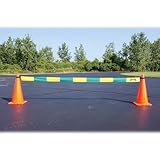
How to Set Up the Net
You can use 2 chairs and a piece of yarn for the cheapest and easiest setup!
Ask your PE teacher if they have these special nets or purchase for yourself.
I created GOAT after watching this PE class game in the video!
Students will compose short melodic phrases using commonly found household items, such as a rock to create “Melodies that Rock.” Younger students can explore music contour in relationship to high and low notes, while older students can write melodic patterns related to their grade level concepts.
Check out the full lesson plan at the VDOE Link below. Lesson plan was altered and adapted for outdoor sidewalk chalk activity.
Disclaimer: The Virginia Department of Education (VDOE) has not evaluated this resource for content nor accessibility. This material is provided “as-is” without warranties of any kind. Use professional expertise in evaluating and using this resource.
I learned about this game from our PE teacher and kids LOVE it. I tried to reconfigure it for music and came up with Pat, Clap, Snap. The objectives-
brain break
using body percussion
team building
Directions:
Two teams in rows. (red and blue above) The object of the game is to get your player from one end of the hula hoops to the other before the other team. Players must jump (2-footed) from one hoop to the next.
One person from each team begins. Those out go to the end of the line & the next person on your team begins at the beginning.
The red team begins at the green hoop. The blue team begins at the yellow hoop. The configuration of the hoops can be in any design as long as there are starting (ending) points for both teams. (In the gym or outside you have lots of room to curve the course all over the place.)
If your music room isn’t very big or you can’t use the gym or go outside, I think sit spots or bean bags would work. Instead of jumping IN the hoop, you’d jump over each spot/bag.
At some point the two players will meet (be facing each other) and that is when they’ll play Pat Clap Snap.
Instead of Rock, Paper, Scissors’ fist-fist-rock/paper/scissors, they will clap two times and then the third beat will need to either be a pat, clap, or snap. If they do the same motion, it’s a tie and they do it again until there’s a winner. The image above is a visual to help them remember what beats the other.
The winner keeps jumping, the loser goes to the end of their line and a new player for that team begins jumping, hoping to stop the other player. Here is the Rock, Paper, Scissors version.
Earth, Wind, and FIRE
Take any upbeat song such as Earth, Wind, and Fire’s “Let’s Groove Tonight” and create easy movement.
How to Move
Intro (stand and bounce to the beat)
Verse (lots of words so keep it simple-WALK to the beat)
Chorus (easier lyrics so stop and do simple choreography)
arms up, arms out, arms down, arms out (repeat)
Bridge (freestyle)
Walking and freestyle are a snap! Just something simple for the chorus and BAM, you’ve got it.
Whether you call them elementary music centers, stations, or small group activities, kids just call them FUN! Setting them up can be tricky, so here are my best tips for making music centers successful in your classroom.
Originally published April 12, 2023 Latest Update September 21, 2026
This post may contain affiliate links. I make a small commission at no additional cost to you. Read my full disclosure.
Why Learning Centers?
Music learning centers were always a HUGE hit with my students! I think there are a couple of reasons.
They loved the variety of the day but also the variety in the music curriculum. It was a SPECIAL day! I usually set them up about 4 times a year, once every 9 weeks.
Centers offer kids a chance to explore lots of musical objectives and are valuable and engaging learning tools.
Fairy tales are great tools for vocal, instrumental, and movement exploration for all students in the music classroom. From simple storytelling to a story with sound effects to a grand production, fairy tales are engaging and capture the imagination.
Start with the story, add body percussion, vocal sound effects, and then transfer to instruments. See the tables below as examples.
Learning how to use Blooket in elementary music is just understanding the basics of the game, assessment opportunities, safety reminders, SEL considerations, and using a list of games I’ve created.
Blooket was created to imitate video games that kids love. It is Kahoot with more game options and can be played solo and as a class.
Originally published May 8, 2022 Latest Update August 5, 2026
Here’s a BIG list of elementary movement activities for K-5 music with DETAILED lesson plans and creative options for your students. Music & movement activities inspire play! You’ll find movement activities that integrate with the Orff approach, Dalcroze, Kodaly, and First Steps in Music.
Finding GOOD elementary movement games & activities for grades K-5 can be a challenge. Ideas need to be engaging and repeatable. If they offer a creative component, they get the ALL-STAR status! Here are my best multi-layered lessons for some of my favorite movement activities.
The best elementary movement activities are integral to a quality music education experience for children by providing ways to express, explore, and learn.
The One-Beat Diner is a 2-page rhythm writing music resource that features a menu full of one-beat (building brick) yummy foods that can be turned into a delicious 4-beat take-out order. Page 1 is a place to create your one-beat foods and page 2 is where you put them into 4-beat patterns.