I'm a mom, wife, teacher, reader, gardener, trekkie, sci-fi fanatic, musician, dog lover, and a Christian. I hope my contributions bring some joy and happiness to your life!
You can now sing, do the motions, and PLAY this Irish favorite, The Rattlin’ Bog, with a lively Orff barred instrument arrangement (and optional ukulele part) for St. Patrick’s Day, all during March, or whenever you want that cumulative song, breathless laughter FUN!
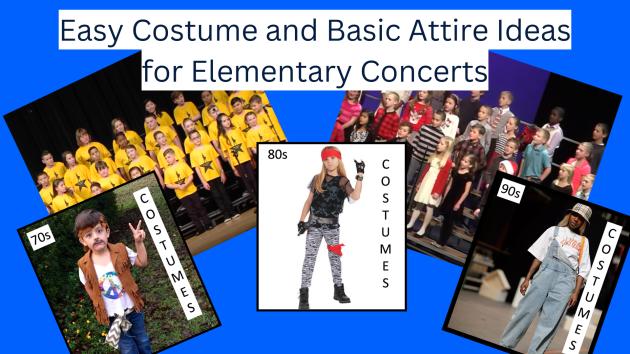
From basic black to an 80s-themed concert, find the perfect costume and attire for your elementary performing group. The goal is to give guidelines that will allow every student the chance to find what they need for the performance.
Fairy tales are great tools for vocal, instrumental, and movement exploration for all students in the music classroom. From simple storytelling to a story with sound effects to a grand production, fairy tales are engaging and capture the imagination.
Start with the story, add body percussion, vocal sound effects, and then transfer to instruments. See the tables below as examples.
Originally published January 7, 2023 Latest Update April 2, 2026
Looking for the best parachute activities for elementary music? This big list guide covers everything from songs, games, and activities to exploring form, melodic direction, rhythm, beat, and vocal exploration.
These activities provide a fun application for music elements as well as physical activity for fitness, a brain break, and a social-emotional learning (SEL) outlet.
Table of Contents
This post may contain affiliate links. I make a small commission at no additional cost to you. Read my full disclosure.
Breaking down a classroom activity by procedures will make your lesson more effective. When activities fail, many times it’s because a classroom routine or process is missing. I spent twice as much planning time on HOW to teach than WHAT to teach.
Are you ready for your kids to have an Orff experience and play instruments but don’t know where to begin? Learn techniques that give kids instant success playing barred instruments in your music classroom.
Using clear terminology and introducing techniques as you play, students will be creating and improvising almost immediately.
The Playlist
How to Play Barred Instruments
How to Teach With Barred Instruments-Day 1
The below video details techniques I found worked very well in my teaching. You may find tips that you can apply or modify for your students.
Fun & Simple Barred Instrument Exercise
Mr. Trevino posted this video and it’s a GREAT example of creating playing opportunities that aren’t songs.
Objectives here would be:
Understanding scales
Correctly echoing rhythm patterns
Mallet technique (alternating hands)
How to play: Mr. Trevino speaks the rhythm pattern on C and students echo play it. C-CCCCC- Then he moves on to D, etc.
Extension: This would make a GREAT center! In groups of 4 for example, one student is the teacher calling out the letters and patterns and the other 3 play. Rotate who is the teacher.
Check It Out! 🎯 This easy-to-use digital tool lets you design and download barred instrument visuals for your elementary music classroom. FREE!
Steps to Playing Barred Instruments
Below are the points I made in the video. The video is great to see it in action.
Getting Started
I turn my instrument so that my low end and their low end are the same direction in the room.
I use room references (window wall, door wall) instead of left and right.
Echo speak in 4-beat phrases.
Explore the low and high sides of the instrument.
Use terms such as long/low/big and short/high/little
Use the note name C and also introduce the octave C in the middle
Use one hand or both hands randomly. Let students do what is natural for them.
Begin to combine echo patterns that use both high/low/middle references.
Stepwise Movement Using Letter Names
Reminders not to PLAY on the letter names if they are located on the end of the bar.
Give them PRACTICE TIME.
Essential Agreements for Barred Instruments
An essential agreement in my room was to Sing, Play, and Speak Beautifully. For students who want to purposefully make noise (smack, hit, overly loud), reminders of this agreement should take care of it. Some kids have motor control issues and this is NOT for them. They are trying! Give them a mallet that creates less sound.
Playing Techniques on Barred Instruments
Not a baseball wind-up but a good basketball dribble bounce.
A nice low bounce that lets the bar ring.
Wrap your fingers gently around the handles. Pointer/index finger should not be straight but curved too.
🔷 If you’re ready for some FREE Orff-inspired resources, check out the Oodles Weekly Newsletter. It’s full of teacher tips & tricks as well as a Subscriber Spot full of FREE resources.
Let’s Play Rhymes
Choose any short poem or rhyme. Starting on low C, play the rhythm stepwise up and down the instrument. Use one hand at a time (just right then just left), then try with two, alternating hands.
Play in different directions.
Play in pentatonic
Improvise or take time for them to create a way to play.
Easy to switch partners if you don’t have a 1-to-1 instrument situation
Create Form & Arrangements on the Barred Instruments
Form: woods, metals, tutti or soprano, alto, tutti or solo, tutti, solo, tutti (for example)
Do a Round Robin
Every student improvises, one after the other. T can play a broken bordun to accompany.
Orff Resources
AOSA (American Orff Schulwerk Association)
AOSA offers Levels (summertime PD) as well as regional weekend workshops. The workshops are a fabulous way to get introduced to all things Orff approach as well as get new ideas for those who are already familiar with Orff Schulwerk.
Orff Arrangements Ready to Teach
Here are a couple of my TPT best-selling Orff multi-lesson resources that are ready to teach and guide you through the process.
Final Thoughts
Lots of my blog posts, videos, and resources come directly from interaction with teachers like YOU!
Ask a question, leave a comment, share a tip in the comments below!
❤️ It helps all of us in the music teaching community!
“We Shall Not Be Moved” transforms itself into a song to remember Black History, Civil Rights, freedom rights around the world, and the power of music with its simplistic style perfect for learning in the music classroom. Perfect for exploring in class or performances, and easily integrated into-
You need to have several “tricks” to pull out of your back pocket when kids need to have a brain break, to expend some energy, to divert attention from something else going on in the room (a potential meltdown for ex.), to prepare them for a high-concentration activity, or when you the teacher need to have a mental break yourself.
And so, the Jumping Game was born!
Stand in a circle
Play a song with a good beat (see Spotify playlist below)
T stands on the outside of the circle and taps a child on the shoulder.
That child goes into the middle and begins to jump
Prepare kids for the jumping game by talking about how they can be creative by using feet together, feet apart, 1 and 2-foot jumping/hopping, use of arms, bending knees, turning as you jump, etc.
Everyone in the circle imitates the leader in the middle
T occasionally comments about some of the fine points of the jumper. “Ooh, did you see how they alternated bending their elbows as they jumped?”
Tap the next child in the circle after about 10 seconds, continuing to make your way around the circle.
In a class of 25, this gave the class about 4 minutes of jumping.
Do you need a ukulele storage solution for your classroom? Maybe the ukes are new or you’ve had them a while and your current storage isn’t working. Here are lots of ideas for hanging, shelf, and rolling cart solutions, or repurposing storage in your classroom.
Commonly Used Hardware
Some of these items are from Amazon and as an Amazon Affiliate, I may earn from qualifying purchases.
Wall Mount Hanger 6 Pack, with Screws – Easy To Install – Fits All Size Guitars, Bass, Mandolin, Banjo, Ukulele Set of 6
Heavy Duty Vinyl Coated Screw-In Tool Hanger 50 lbs from Home Depot. A little over $2 each.
I initially used this toy storage bin (to the right) to store my ukuleles. (to the left) I used the tubs, which are SO strong, for small percussion storage in a shelving unit. Loved that the bins were in different sizes.