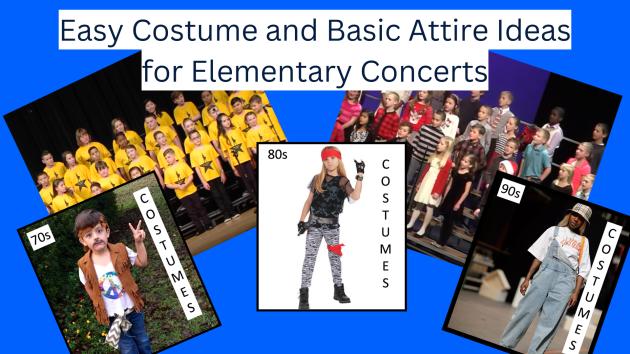
From basic black to an 80s-themed concert, find the perfect costume and attire for your elementary performing group. The goal is to give guidelines that will allow every student the chance to find what they need for the performance.
Having elementary students memorize music and be concert ready can be tricky and time-consuming. This post will give you multiple tips and techniques, including incentives, checklists, and games, for learning and memorizing music to prepare your students for a concert.
The Playlist…
Learning the Music
Here are tips to help students learn their concert music. You can use teaching techniques, games, incentives, and challenges to keep the lessons varied and interesting.
Rhythm, Melody, and Lyrics Techniques
Project lyrics using Google Slides or PowerPoint in grades 2 and above. For PreK-Grade 1 you can project some key words/image icons that begin phrases although many times, I taught the songs by rote with no projection. I tried to pick songs for the younger kids that had lots of repetition so learning the text wasn’t a problem.
Have students analyze the text looking for repetition, similarities, and differences.
Let students find the rhyming words and use color-coding on your slides.
Depending on the song, you may want to echo sing phrases, learn by listening to a recording, practice a few probable melody or rhythm trouble spots with echoing.
If the song is wordy, learn the chorus first and then slowly add the verses.
Sing a cappella sometimes so they can really hear themselves and the class.
As much as possible, do not sing with them. They will become stronger singers as you get away from singing with them or using full-performance tracks.
It’s really hard for kids to learn a song by repeatedly singing with a full-performance track. A full performance track can be an introduction to the song. Use the accompaniment track if you aren’t using piano, guitar, other, etc.
Music Resources & Ideas for the works of Amanda Gorman.
Amanda Gorman’s children’s books are the perfect inspiration for elementary music concerts and classroom activities. Here are a variety of Amanda Gorman music resources and ideas based on her books, Change Sings and Something, Someday.
The Playlist
Change Sings
With her poetry of words, Amanda Gorman’s “Change Sings” uses a story full of music vocabulary to invite children to be the change in the world with acts of kindness. Here are songs that fit into that theme.
The Change Is You
Amanda Gorman’s book, “Change Sings”, inspired this new 3-part round song, The Change Is You, that uses an African proverb to begin the journey of a call to action to be the change in the world.
Change the World, With Kindness
Written for younger singers,Change the World With Kindness reinforces the act of kindness themes in Amanda Gorman’s book, “Change Sings.”
With lots of repetition and sequencing, this easy-to-learn song is a perfect concert selection. The resource includes suggested movements and opportunities to create your own movement.
“With intimate and inspiring text and powerfully stunning illustrations, Something, Someday reveals how even the smallest gesture can have a lasting impact.”
As an Amazon Affiliate, I make a small commission at no additional cost to you.
Seeds of Change
If you’re looking for a classroom song about Earth Day, the environment, and making a difference or a sparkling elementary music concert selection that’s simple to learn and features students playing instruments, this is it!
Seeds of Change is a song about making a difference, an environmental call to action about caring for our outdoor spaces, set to a Latin-feel Orff arrangement with lots of maracas representing the “seeds.”
From backdrops to props, decorating your stage for concerts takes a lot of thought. Everyone’s performance venue is different. Teachers use walls, the front of the stage, items hanging from the ceiling, to nothing at all. Remember, if you use risers, any decorations behind them will be hidden when your students are there.
Table of Contents
How to Make Paper Bag Snowflakes
Easy-to-make paper bag snowflakes. Students can help!
Stage Decorations for Less
Some concerts may have a theme or color scheme that is used at other times of the year. You can often find these items at Dollar Tree and similar stores or more high-priced stores AFTER the holiday and on sale.
Fourth of July Decorations-Use for Veterans Day or general Patriotic Concerts
Summer Beach Theme in May/June-Use for beach/ocean-themed concerts.
Stage Decorations
Great Collaborations
The art specialist and music teacher collaborated for a beautiful student experience. The first-grade program was a take on “A Night Before Christmas.” The Art Specialist made the stage look like their school!
Winter & Holidays
Garland & Bows
Any Time of the Year
Spring or anytime you want flowers, get all the colors or patterns from Dollar Tree and create fun flower backdrops. Just glue 5 plates in a circle, add a big and small plate to the center. The green leaves might not be needed if they’re going to be covered up by risers the entire concert.
Circus Theme
Get information for finger lights, black lights, flashlights, glowsticks, light-up drumsticks, and more!
If you’d like TIMELY tips delivered to your inbox, every Monday morning, get the Oodles Newsletter!
Processing…
Success! Use the PW: MUSIC4LIFE to unlock FREEBIES on the Subscriber Spot tab in the top menu!
Whoops! There was an error and we couldn't process your subscription. Please reload the page and try again.
You might also like these other concert-related resources.
Are you looking for elementary concert lighting that dazzles? Here are ideas and resources for using blacklights, glowsticks, flashlights, fluorescents, and drumsticks that glow.
Links to sources on this page may be affiliates and as an Amazon Associate, I earn from qualifying purchases.
How-to checklist to put on a fabulous music concert!
Planning an elementary music concert is a complicated process. Find teacher-tested tips for choosing your music, concert themes, teaching timelines, and logistics.
Elementary Music Concert Ideas
How do you plan for a successful elementary music concert?
Oftentimes big mistakes can be avoided by simply being aware of an essential element. Read through this page and you’ll find time and teacher-tested ideas that will get you going in the right direction.
Let’s start with when to introduce the music to your students.
When to Begin Teaching the Music
There’s nothing worse than realizing you don’t have enough time to prepare your students for their concert. From the poll below, the winning timeline for a December concert…
Semester I: Early to mid-October (8 or more weeks out) is currently winning in the poll!
Don’t wait until after Halloween to begin teaching the music!
Semester II: Considering the answers from Semester I, you want to have 8 or more weeks for your students to learn and memorize their music.
Mid-May concerts-begin at least by early March
Mid-April concerts-begin at least by early February
Please take the POLL below! Thanks to all who participate!
Elementary Music Concert CHECKLIST
Timetable
Choosing the music. How to choose the music?
When to begin learning the music-you want your music memorized a week before the concert.
Physical location
risers
chairs
piano
decorations
Music
Will your program have a theme or random songs?
How many songs? If a song is 2 minutes in length, then 10 songs are about 20 minutes of minutes. How long for transitions between groups? Think in those terms. A typical length for a concert is 45 minutes.
Binder-put your music in a binder to keep it all in one place. Put all of your notes in there too so you have a record of what you did to refer to for the next concert.
Transitions-as one group exits and the next enters, will you have transition performances? piano solo, background music, audience sing-a-long, or nothing
Sound system-this is so different for each school.
Student logistics
Where will students wait before and after they perform?
Riser etiquette-how to get on and off the risers and how to stand on the risers once you are on them. Also, how much spacing between students.
I always created “riser spots” in my classroom so I did not have to do it during on stage rehearsal time. I had kids get in one long line by height, tall to short, and then I divided the number by 4. (3 rows on the risers and then one on the floor). A class of 24 then will have 6 to a row. The first 6 students become the back row, next six the third row, etc. Then I write down the names so I have a record for myself and for the classroom teacher if they are going to help me.
I figured riser spots a couple of weeks before the performance so that in music class we’d often practice getting in our riser spots and get used to singing in that configuration.
I taught at a school that had only about 25% participation in after-school concerts. The above idea of riser spots was great for our performance during the day, but was useless that night when so few showed up. My great PE teacher friend was always there backstage to place the attending kids in height order. The curtains would open and I never knew who would be there, but they always looked fabulous because of my PE buddy.
Programs
if you create paper programs, who will hand them out or where will they be placed for the audience to pick up.
Rehearsals
you must figure out if you are going to have rehearsals with individual classes, grade levels, or the entire performing group.
Attire
you must figure out whether you are going to have students wear school uniforms, dress up outfits, or a certain color top and bottom.
Communication
To parents-when, where, and what time for the concert and what their child should wear. Ask Ts to put the info in their weekly newsletters as well.
To teachers-are they helping with logistics the day/night of the program. Give them plenty of information about what to do.
To admin-I would meet with my admin and give them a rundown of my plan for the day/night and ask them any questions.
To custodians-Are they helping with setup, tear down, clean up. Make sure you have clearly communicated to them.
At the concert-I make a final list of what I need right there in front of me such as my binder, a music stand for my binder, my computer, and always a reminder to always turn off notifications on my phone and computer.
The Oodles Newsletter
If you’d like TIMELY tips delivered to your inbox, every Monday morning, get the Oodles Newsletter!
Processing…
Success! Use the PW: Oodles21 to unlock FREEBIES on the Subscriber Spot tab in the top menu!
Whoops! There was an error and we couldn't process your subscription. Please reload the page and try again.
Choosing The Music
Choosing your elementary music concert songs and theme can be your biggest stumbling block.
And no two situations are the same related to who sings, the performing space, music budget (usually no budget), and the big one…
How to find songs my students will want to sing!
Determining Who Sings
A typical program is about 45 minutes in length. Songs can last between about 45 seconds up to 2:30. But if your average song is 2 minutes, you would need 22 songs for that length of time.
WHAT? If people only knew.
Of course, there will be some transition time but really, an audience doesn’t want to watch too many minutes of kids getting on and off the stage or listening to narration. So if you need 18 songs, how are you going to do it?
If you teach at a school with large grade levels, you will probably have grade level concerts so “The Third Grade Spring Concert!” You might not have room for all the third grade at once so you would divide the songs by the number of performing “groups” that you would use.
The same idea is true if your school is smaller and you have more grade levels at one time so “The K-2 Spring Concert!” Maybe then kinders would sing together, then grade 1, and grade 2, so three groups. If you have 3 performing “groups” and if each group sang 5 or 6 songs, you’d be good to go.
Music Selection & Themes
Themes can be easier because it helps with song selection, what you ask your students to wear, and decorations. The theme should be broad enough to let you find the songs you need. If it’s too narrow (Frogs Are Fun), it’s going to be hard to find enough songs.
The Song Database page has some common themes and titles within the Google slide database and also below it on the page.
No theme though is a perfectly great way to include lots of activities that you’ve been doing in class. “The Spring Concert” could have singing, bucket drumming, recorders, ukes, etc. with a wide variety of songs and pieces and no over-arching theme.
Concert Songs Tips & Tricks
These were my go-to tricks that might help you.
When to Teach the Songs
Start the music EARLY. If I had a December concert, I started the end of September/early October. Kids get bored with songs, but once they know them, you can always teach something else and then come back to the songs closer to concert time. There’s nothing worse than feeling like the kids aren’t going to be ready and if you wait and take it down to the wire, I can guarantee this will happen-
a grade level will go on a field trip
a grade level has been scheduled for their annual human growth talk
the teacher has a special visitor in to show the class about reptiles
picture day
makeup picture day
an all-school assembly program during your class time
Where to Find Concert Songs & Accompaniments
Find your music through
Online music subscriptions-Musicplay, Essential Elements (Hal Leonard), Quaver, etc.
Facebook Music Group searches
my database (linked above)
Music K8
old textbook series (they have master indexes by subject, genre, etc)
YouTube (search “elementary concert”)
online music stores (JW Pepper, Sheetmusic Plus)
Accompaniments
Accompaniment Tracks-MK8, online stores (the mp3s are usually expensive, but…), search Apple music for “instrumental” or “karaoke”
Mass Groups-I always liked to have as many kids as possible performing so I had risers on the stage and on the floor so I could get 4 classes singing together. This made for a gorgeous big sound AND if you had that one class that didn’t know the music as well as the others, it didn’t matter.
One Extra Song-In the early stages, if possible, teach/introduce one song MORE than you think you’ll need. After a couple of weeks, you’ll find that there’s one song that just isn’t working and you can just let that one disappear and go with the ones that are proving to be better and stronger.
Student Choice-Do NOT let the kids pick the songs because one class will pick Song A and the other will pick Song B and then you’ll be in a pickle. If a class is performing by themselves, then you have the same problem because half the class will want Song A and half will want Song B. I always found it a no-win situation.