Looking for creative teaching ideas for nursery rhymes and songs in elementary music classes? If you’ve ever felt stuck doing the same fingerplays or songs over and over, you’re not alone.
How can we make nursery rhymes more musical, more interactive, and more developmentally rich, without spending hours in planning?
In this post, you’ll find a big list of ways to use nursery rhymes as springboards for movement, beat work, rhythm exploration, singing, storytelling, and more.
Whether you’re teaching short 20-minute classes or planning for centers, there’s something here you can plug in and use right away.

This post may contain affiliate links. I make a small commission at no additional cost to you. Read my full disclosure.
The Playlist
Why Use Nursery Rhymes in Music Class?
Nursery rhymes are packed with:
- Repetition and rhyme
- Simple rhythms and phrasing
- Playful language that’s perfect for vocal exploration
- Built-in story structures that support sequencing, improvisation, and creativity
And the best part? They’re familiar to many students already. Even when they’re not, the short length makes them easy to teach in just a few minutes.
How do we generate new teaching ideas for nursery rhymes and songs we’ve known forever?
Generate & Streamline Teaching Ideas for Nursery Rhymes and Songs With a Template
Choose a rhyme and then plug it into the below template: Introduction, Beat & Rhythm, Singing & Vocal Exploration, and Phrasing & Storytelling.

Grab this free template for creating multi-lesson plans for your nursery rhymes and songs!
💡 Here are more ideas about how to use this template!
Introduce the Rhyme
Introduce the rhyme by saying it for the students with lots of expression. You may want to do some echo speaking to help students learn it. Depending on the rhyme, you can add motions and body percussion. You can then go straight into Beat & Rhythm activities or save it for the next lesson as part of your multi-lesson approach.
Beat & Rhythm
Nursery rhymes are the perfect launchpad for beat & rhythm exploration. Try these ideas:
- Echo speak the rhyme one line at a time, using natural rhythm or speech syllables
- Keep the steady beat with body percussion (tapping legs, patting shoulders) or beanbags on knees
- Use rhythm sticks or egg shakers to add sound and structure
- Create a beat-passing game around the circle while saying or chanting the rhyme
- Tap the beat while students speak the rhythm. Switch.
These activities reinforce beat vs. rhythm and help your youngest learners internalize musical timing without needing formal notation.
Singing and Vocal Exploration
These quick ideas turn simple rhymes into rich vocal exploration experiences.
- Melody: If the nursery rhyme doesn’t have a known melody, try singing it with sol-mi or sol-mi-la.
- Arioso moments: Invite students to make up short melodic lines using the rhyme’s text (inspired by Feierabend’s approach to spontaneous singing)
- Character voices: Speak or sing each line using a different voice (high, low, squeaky, giant, animal)
- Melodic direction: Choose words that suggest pitch movement (“up,” “down,” “fall,” etc.) and move your voice with the word
- Add a vocal slide or glissando on key words for fun and expressiveness
Rhyming, Phrasing, and Story Play
Nursery rhymes are short stories in disguise. Use them to build phrasing awareness and storytelling skills.
- Rhyming games: Pause before the rhyming word and let students fill in the blank
- Partner phrases: Take turns speaking each phrase with a partner, then switch roles
- Create new verses using the same rhythm or structure
- Act out the story with puppets or stuffed animals
- Story sequence with picture cards. Students place them in order or tell the story themselves.
- Have students color a scene from the rhyme and retell what happened or a coloring page that already sequences the story.
All of these support memory, listening, sequencing, and creative thinking.
Nursery Rhyme Centers for Elementary Music
Prek, kindergarten, first grade, and second grade nursery rhyme centers are a great way to give students hands-on time with rhymes, especially in shorter class periods.
These ideas are a natural follow-up after experiencing the whole-class teaching above.
- Voice choice cards: Students speak the rhyme using silly voice cards (robot, whisper, giant, mouse)
- Rhythm center: Use rhythm sticks or drums to tap the beat or create a new rhythm for the rhyme
- Story sequence puzzles: Give students cards to place in order (beginning, middle, end)
- Beat maps: Students move a small object along a path as they say the rhyme, tapping the beat
- Puppet play: Students act out the rhyme alone or in pairs using simple puppets or stuffed animals
These centers don’t require tons of prep, but they reinforce musical concepts and keep students engaged.
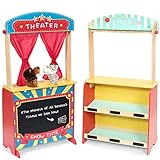
My puppet stage was loved by ALL my younger students. (older students would beg to play too) Here’s a smaller version of the one I used.
If you want to see the big stage from my classroom, check it out (and other favorite items) on my Amazon Storefront!
As an Amazon Affiliate, I make a small commission at no additional cost to you.
Nursery Rhyme Lesson Plan Examples
Here’s a quick example of how you can take one rhyme and expand it into several music-focused activities. You’ll find a full visual of this in the infographic below.
“This Old Man”
- Introduce: Sing with motions
- Beat & Rhythm: Play rhythm sticks on “knick knack paddy-wack”
- Singing: Replace “man” with mouse and sing with a high voice. (elephant/low)
- Phrasing & Storytelling: Coloring page with the ten verses
“Pease Porridge”
- Introduce: Echo speak/clap the rhyme, discuss porridge and who eats oatmeal (hot? cold?), food likes/dislikes
- Beat & Rhythm: Using small percussion, play the rhythm, the beat, then only on the rests.
- Singing: Vocal exploration-speak entire rhyme in high voice then low voice then alternate phrases with high and low. Partners try different ways to use high/low speaking voices.
- Phrasing & Storytelling: Split phrases between teacher and students, switch. Have partners explore who says the phrases.
“Miss Mary Mack”
- Introduce: Speak with motions. Teacher speaks beginning of phrases, students say all repeated words.
- Beat & Rhythm: Explore which repeated words use 1, 2, and 3 syllables. Play those on instruments.
- Singing: Speak the poem but sing the repeated words on a pattern such as mrd or ds’s’ or d’d,d, or similar
- Phrasing & Storytelling: Have students place sequence cards in order. 1. Miss Mary Mack 2. Dressed in black 3. Silver buttons, etc.

Final Thoughts
You don’t have to reinvent your nursery rhyme lessons from scratch. Just one rhyme can turn into five or six different experiences over multiple classes, all tied to musical concepts you’re already teaching.
Repetition is so important! When students revisit the same rhyme in different ways, it strengthens their musical memory and gives them chances to learn new elements in new ways.
Got a favorite way you use nursery rhymes in your classroom? I’d love to hear about it. Drop a comment or tag me on Instagram @oodlesofmusic to share your ideas!
